Wednesday, June 13, 2012

Are you ready for your culinary close up?


Culinary Close Ups

Pretty in Pink: peel 'n eat shrimp Florida and Georgia coast menus

It’s not enough to simply relax and dine on the dishes chefs create for restaurant menus, some folks want to jump in and help cook the meal.  The promise of an “Epitourian” experience in the professional kitchens of the Sawgrass Marriott Resort in Ponte Vedra Beach, Florida is what attracted Maureen and Billy Ray Price of Moultrie, Georgia. “I found it online. We wanted to go to the beach to celebrate our wedding anniversary but we wanted something different,” says Maureen Price. “My husband is a really good cook and I thought ‘he’ll learn to make even more great things for me’ and it will be fun.”
So while other guests at the golf centric resort, host hotel of THE PLAYERS Championship, headed out to play one of the areas eight championship golf courses or grabbed a book and a beach chair at the Cabana Beach Club, the Prices jumped on a golf cart with Executive chef David Scalise to visit the on-property bee hives.
Off they go to find the bee hives with Chef Scalise and Heidi Barfels of Miami

Scalise tends two bee hives tucked away in an area guests wouldn’t normally see behind tall trees and overgrown with black berry bushes and other natural plants of north Florida, “At first everyone panicked when they heard I wanted to set up bee hives on the hotel property. But these honey bees are not aggressive and finally even the lawyers understood it was going to be OK, “ says Scalise who set up the hives about a year ago. 

Sweet life: Executive Chef David Scalise tends the hives at the Sawgrass Marriott Resort

“Our first harvest yielded fifteen gallons. The honey is a little nutty tasting with nuances of the wild blackberries. We use pieces of the honey combs on our cheese platters.”  The hotel’s homegrown Sawgrass honey not only sweetens the culinary program, it’s sold in the gift shop and used in the spa for treatments. “We’re even working on using the bees wax to make lip balm, “ says Scalise.  
Proud beekeeper shows off part of the honey harvest.

He says another bonus from beekeeping is developing stronger relationships with local farmers, “We lend our bees to pollinate their crops including a strawberry farmer nearby. So then we get strawberry honey.”
Cook and Learn
Next stop for the Prices on their culinary adventure is the farmer’s market in nearby Neptune Beach to shop for foods they’ll cook with that afternoon.  On the menu for today is a lesson in making fresh pasta.  “I’ve always loved to cook. Even in college at the University of Florida I made spaghetti sauce every Sunday for the other students in my dorm,” says Billy Ray Price who’s a physician in Moultrie.   
Romantic lighting in the Augustine Grille captures the beauty of handmade gnocchi pasta with local vegetables.

A few notches up from spaghetti, Scalise led the Prices through the steps needed to make fresh gnocchi including the delicate broth based sauce that would be served to them for dinner that night as well as other guests in the Augustine Grille. So their “epitourian” experience went beyond creating their own courses, the Prices truly were part of the Sawgrass Marriott’s culinary staff for the day.

Maureen and Billy Ray Price celebrate their Epitourian experience in the Augustine Grille

Watch and Learn
If you’d rather stay out of the line of fire in a busy restaurant kitchen, but still want to be close enough to see exactly how the chef sears a piece of fish then you can take a seat at the Chef’s Table at The Cloister at Sea Island, Georgia.  

Elegant settings and sumptuous bites of the finest food and wine at The Cloister, Sea Island

Seating four guests comfortably in a small yet elegant glassed-in dining room the table overlooks the expansive kitchen of the Georgian Room where chef de cuisine Daniel Zeal and his brigade of chefs turn vegetables into jewel like shapes, expertly grill meats, poach lobster in vanilla and citrus, delicately prepare fine fish such as cobia, garnish plates with edible flowers and create multi-ingredient desserts.  Can’t keep up with the action? Just change the channel.  Above the picture window in the chef’s table dining room is a wide screen television. “We give the guests their own remote control to switch camera views around the kitchen so they can follow their meal every step of the way and I pop in to answer any questions they might have about techniques or ingredients,” says Zeal.
Under the direction of  Resort Executive Chef Jonathan Jerusalmy, Sea Island chefs
create a wide range of culinary experiences for guests.

Off the Farm
Snapper ceviche with micro greens at Edwards Fine Food & Wine, Rosemary Beach,  Florida
It’s nothing new to see the names of farms and farmers on menus today as more chefs create business bonds to bring the best in locally grown foods to their guests. But, take a look around the dining room and you may even see a farmer. 

Eating dinner one night at Edward’s Fine Food & Wine in Rosemary Beach, Florida I asked chef Edward Reese about the deliciously fresh micro greens in salads and garnishing plates. He smiled and replied pointing to the man sitting at the next table, “Why don’t you ask Claus Kazenmaier, they came from his farm this morning!”
So it seems that another component of judging culinary quality is today is how close we can get to knowing where our food comes from and exactly how it’s prepared even when someone else is doing the cooking.
Now let's head to the beach..........


Tuesday, June 5, 2012

Chefs and their Menus


What’s on the menu? That’s a critical question chefs must decide before they open a restaurant.  “I was afraid. It was like writer’s block. I needed a point of view,” says Joe Truex, executive chef of newly opened Watershed on Peachtree.  Truex, no newbie to menu development has cooked in professional kitchens from his home state of Louisiana to flashy Las Vegas to the renowned Le Cirque Restaurant in New York. After graduating from the Culinary Institute of America in 1989 he set off to Switzerland to immerse himself in European cuisine and then after another stint in demanding Manhattan kitchens including the glamorous Peninsula Hotel decided to head south.  The menu of his former Atlanta restaurant Repast even caught the eye of Martha Stewart who invited him to appear on her television show.
It was a combination of these culinary experiences that led Truex to define what he wanted to cook at Watershed on Peachtree, “I decided that the menu for Watershed on Peachtree should be personal. I wanted to make it an autobiography of my life.”
So, on the menu you’ll find Joe’s Jambalaya, an homage to his upbringing in Mansura, Louisiana. “But it’s prepared in a classical style with everything cooked separately. I grill the sausage. I sear the scallops,” says Truex.  The Grilled Steak and Panzanella  Salad he learned to make at Le Cirque, ”It was owner’s Sirio Maccioni’s favorite.”
The focus of the menu is farm –to- table with locally grown produce and southern staples from pork to pecans. One item Truex had to include in his new menu story is Watershed’s famous fried chicken night (Wednesday), made popular at the eatery’s former Decatur location.
OK, I didn't' have a photo of fish at The Optimist but here's me with a trout in Aspen!

Go Fish
Everyday has a catch- of- the- day when you open a seafood place. Chef Ford Fry has launched The Optimist and Oyster Bar in west Midtown with executive chef Adam Evans at the helm. Last month after lunch at Fry’s JCT Kitchen, I saw Evans sitting outside with chef de cuisine Brian Horn, working on laptops and legal pads designing the menu for The Optimist.
Here's one of the delicious dishes I shared  for lunch at JCT Kitchen that day. 

That’s when it hit me that writing a menu is complicated business. Not only do you have to think of culinary mission of the menu and food costs; you have to consider who’s coming to the restaurant, do they want big plates or small plates, do they care about local farms and sustainable seafood, do they want to start with a salad, will they share dessert, do they crave hand crafted cocktails?
Mixologist, Laura Creasy is the mind behind the bevy of beverages on the menu at JCT Kitchen and The Optimist. 

The answer is usually yes to all of these questions today. And while it’s hard to please all of the people all of the time, seafood lovers dining at The Optimist will find a sea of offerings from delicate grouper with smoked Vidalia onions in a horseradish broth to down home fish house fried hushpuppies dusted in cane sugar. 
Dream Menu
As a dietitian who loves to dine out here’s what I like to see on the menu.
-Sensible portion sizes. It’s nice when the servers can tell you if the fish entrĂ©e is big enough to share or if you should just get your own.
-Healthy appetizers. Too many starters are deep fat fried or loaded with cheese. Great choices are seafood ceviche, steamed shellfish, simple salads of great greens or heirloom tomatoes with fresh herbs and without cheese.
- Clean tastes. Chefs love to make rich sauces, but too much can over power the flavors of fish or any food. Don’t gild the lily.
- Flavors without fat. The Optimist’s wood roasted Amish chicken with a fresh salsa verde is a good example. So is Watershed’s salmon with tomato and herbs.
The Old Salty Dog at The Optimist with fresh squeezed pink grapefruit juice and an impressive slab of grapefruit peel.
-Slim and stylish. Used to be that pungent foods such as Brussels sprouts and grapefruit were menu outcasts. But happily and healthily they’re now in vogue.


Salt and Flavor Savvy


Pepper may be used to add the heat, but when it comes to diet debates the seasoning closest to the fire is salt.

Talk about spicing things up!

Government health officials have declared the sodium in table salt as a nutrition no-no with advice to limit intake in home cooking, restaurant menus, processed foods and school lunches. Sodium levels in foods have been on the nutrition watch list for years because research studies show that too much sodium in the diet is associated with high blood pressure, which can increase the risk for heart attack and stroke.


Meanwhile, there’s a heaping helping of scientists who say the salt warnings are way overblown and that there’s not enough research to prove that even if it does raise blood pressure a bit that salt consumption causes heart disease deaths.

So who should care about consuming way too much salt? Just about everyone, according to health watchers at the Centers for Disease Control and Prevention who report that 70% of U.S. adults should limit sodium intake.

The U.S. Dietary Guidelines recommend healthy adults consume no more than 2300 milligrams of sodium (about one teaspoon of salt) per day. A lower limit of 1,500 mg per day is recommended for adults with high blood pressure, diabetes, kidney disease, the over 50s, and all African-American adults.

FYI: most of us consume around 4000 milligrams of sodium a day (about two teaspoons).
Fish tacos and a Margarita with salt on the rim! Just don't lick the whole rim.

Cut Salt, Not Flavor


A big challenge for restaurants is that creating foods lower in fat and calories often means adding flavor with other ingredients such as sauces and salty spice blends which are often high in sodium. Nutrition Facts labels on packaged foods list sodium content to help you keep track. Some chain restaurants provide sodium information on their websites. But, in general when dining out you're often on your own.


  • The main source of sodium in the diet is salt or sodium chloride, with 2, 325 milligrams of sodium per teaspoon. Most salt comes from processed foods such as salad dressings, soups, cheeses, baked goods and snack foods. So cut back on portions or choose lower sodium versions; there are many better tasting ones on the market today.
Hot chiles, citrus, herbs, hot sauces add big flavor so you can use just a little salt.


  • Taste buds adjust. Scientists who study taste have found that when you cut back on salt you get used to it in about three weeks. You may even discover the real flavor of foods!

    A squeeze of tart lemon brightens flavors so you don't need as much  salt.  
  • Note that pickles, cheese, smoked meats, gravies, sauces, salad dressings, barbecue sauces, soy sauce and broths are usually high in sodium so use sparingly. A tablespoon of soy sauce, for instance, contains 1,000 mg sodium. Hot sauces are often sodium free; read the labels.
  • Ask the server for help. Request that foods be prepared without added salt, or ask for sauces and salad dressings on the side. For low-sodium dressings, try lemon, lime or a splash of vinegar. Get to know the delicious difference between the taste of red wine, sherry, rice wine, balsamic and cider vinegars.

  • Look for menu items you can season at the table, such as a baked potato instead of mashed potatoes. Surface salt, such as a light shake on scrambled eggs or fresh sliced tomatoes, can give you the salt flavor hit you crave with just a small sprinkling. Even if those who don’t worry about salt and their health must agree that too much salt in a dish unpleasantly overpowers the other flavors.
  • Upgrade your saltshaker. Sea salt (which by weight contains the same amount of sodium as regular salt) is often brighter and livelier in flavor so you can use less salt to season foods. Amy Myrdal, registered dietitian with the Culinary Institute of America’s campus in Napa Valley notes that all salts are not alike, “Kosher Salt which is very soft and fluffy has granules that melt quickly on the tongue and 1 teaspoon contains only 1120 milligrams of sodium compared to regular table salt with 2,360 milligrams.”

  • Eat more spinach, cantaloupe, oranges and other fruits and vegetables. They’re naturally low in sodium and are excellent sources of the mineral potassium, which acts as the healthy counter-balance to sodium in body fluid regulation. Salsas made with fresh fruit and vegetables are a great way to add healthy flavors to foods.


Carolyn O'Neil, is a registered dietitian and co-author of  "The Dish on Eating Healthy and Being Fabulous!"  Email her at carolyn@carolynoneil.com

Monday, May 28, 2012

Healthy Foods You Already Love!


Do you flip-flop over what you think you like and what you think you should eat?
Win-Wins for Taste and Health


There’s no need to choke down chia seeds, develop a taste for tofu or eat any other foods wearing a trendy health halo if you don’t really like the taste of them. Choosing foods to improve the quality of your diet should start with recognizing what you’re already doing right. Do you add blueberries to yogurt or snack on a few pecans? You’re upping your intake of disease fighting antioxidants. Do you like to carry bottled water in your car? You’re more likely to stay hydrated and not confuse thirst for hunger. Do you go for the mustard and go light on the mayo when ordering sandwiches? You’re choosing big taste without big calories.
 Anytime you add more vegetables to a meal, use less cheese, choose leaner meats, grab the whole grain version of breads and go easy on the butter and oil-you’re right in step with the list of things to do to eat a healthier diet.
So rather than convincing you to try – chick pea cakes with flax seed granola (which I just made up but might actually taste good!)- or some other super nutritious sounding food let’s celebrate some of the dishes you may already be enjoying but, might not have known how healthy they really are.
Win-win for Taste and Health
Why not add some chopped fruit to your Guac?

  • Gaucamole- Since the main ingredient is avocado guacamole is a good source of heart healthy mono-unsaturated fats. The impressive list of nutrients in avocados includes fiber, potassium, Vitamin E and folic acid. Of course, where there’s fat; there are calories. One ounce of avocado, which is 2 tablespoons of mashed or two to three thin slices contains about 50 calories. But compared to two tablespoons of butter at 200 calories you can see why using avocado as a spread is a healthy idea. The mix of chopped tomato, onion, cilantro and jalapeno added to avocado to make guacamole actually lowers the calories and increases the fiber and vitamin content even more per bite. Just make sure not to eat too many fried tortilla chips (6 large- 130 calories). Enjoy with torn pieces of one corn tortilla instead (70 calories).  Or better yet with carrots, celery or jicama – a super crunchy and slightly sweet root vegetable popular in Latin cuisines. 
BBQ Chicken Flatbread!

  • BBQ Chicken – Here’s the bottom line if you’re aiming to reduce your bottom line or waistline - batter and deep fry a five ounce chicken breast and you’re chomping on 500 calories. But, if same size chicken breast is dressed up in barbecue sauce instead you choice is 350 calories – a 150 calorie saving. Want some more sauce to moisten the meat at the table? Most barbecue sauces contain only 15 calories per tablespoon. (The sweeter, thicker ones will be higher in calories.)
Seafood dishes are win-wins for taste and health
even with pasta if you choose a tomato based sauce.

  • Peel ‘n Eat Shrimp- The USDA’s My Plate dietary recommendations suggest we eat fish and shellfish at least twice a week to mix up our protein choices and consume seafood’s heart healthy Omega-3 fats. Shrimp are exceptionally low in fat and calories, especially if you keep them that way by enjoying boiled shrimp (¼ pound of boiled shrimp-112 calories, 1 gram fat) instead of fried (274 calories, 15 grams fat). Peel ‘n Eat Shrimp are often boiled with a spicy seasoning so all you need is a squeeze of lemon and you’re ready to dig in. And since all that peeling takes some time, it slows you down a bit so you’re more likely to keep portions in control. (Yes, shrimp contain some cholesterol, but because they are so low in total fat they’re considered a healthy choice.)
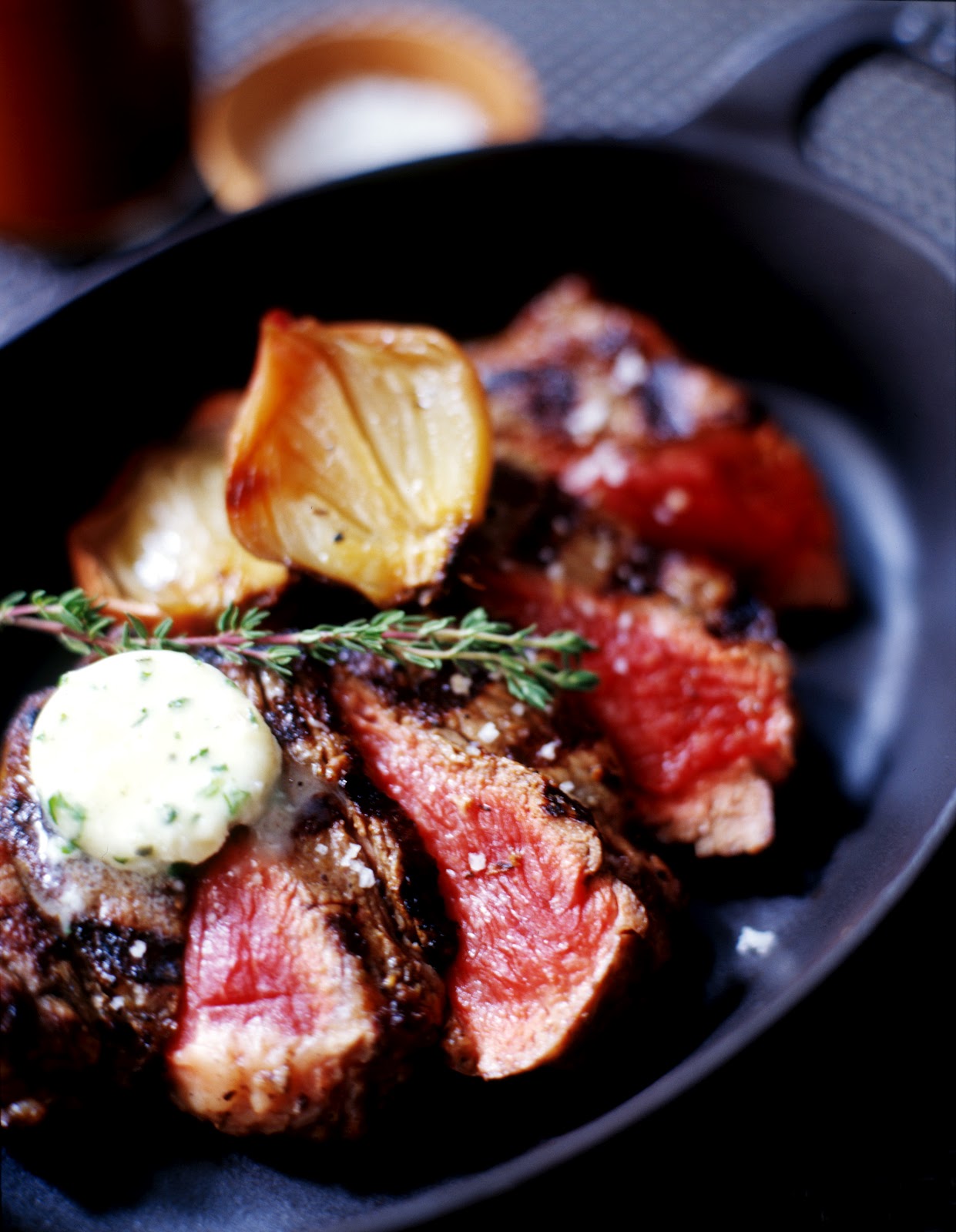
Hangar steak ( I'd skip the ball of herb butter) is a lean and flavorful choice .

  • Sirloin Steak- If you’re going out for a steak dinner ordering a sirloin steak can help you save on both your food dollar budget and your fat and calorie budget. Not as pricey as filet mignon or porterhouse, the sirloin cut is one of the leanest. A six-ounce top sirloin steak, strip steak, flank steak or London broil has about 300 calories and about ten grams of fat. Splurge on the same size serving of prime rib or rib eye and you’re looking at an additional 100 calories 10 grams of fat per serving. Want some sauce with that? 2 tablespoons of steak sauce-30 calories vs. 2 tablespoons BĂ©arnaise sauce-120 calories. Better yet enjoy steak with sautĂ©ed onions and mushrooms and you’re adding more vegetables to your steak dinner.


Sushi is a win-win for taste and health, just avoid the "sushi" with cream cheese
 or other "don't think they eat this in Japan" stuff.
  • Spring Rolls- No, not the deep fried egg roll kind- sorry. But, you can dig in and enjoy the Tai basil rolls popular on many restaurant menus, today. Wrapped in chilled rice paper and filled with fresh veggies and maybe bits of shrimp or chicken they’re a low calorie, high fiber finger food full of crunch and flavors. Low calorie dipping sauces range from sweet and spicy to pungent fish sauces.
  • Gelato- La dolce vita! Italian gelatos are commonly made with milk not cream so are lower in fat and calories than ice creams. But the real plus for a portion control conscious sweet tooth is that gelato is usually served in a dainty half-cup serving. Enjoy sliced strawberries, blueberries or summer’s sweet mango as a topping and you’re adding a fruit serving to your dairy dessert.

Banana gelato sounds great! And apparently  you can use the banana peels to make a pair of shoes!


Tuesday, May 15, 2012

Southern Foods Y'all


When Richard Blais arrived to join other top named chefs presenting cooking classes at the Loews Hotel assembled for the 2012 Atlanta Food & Wine Festival he showed up with a bunch of leftovers. “I had a chicken carcass in a pan, some celery tops, cilantro stems and the tails trimmed off of radishes,” said Blais, a winner of Bravo’s “Top Chef All-Stars.”

Chef Richard Blais gets creative with everythying in the kitchen

Blais, who is busy writing menus and getting the kitchen set up to open his latest Atlanta restaurant, The Spence, wasn’t taking short cuts or trying to underwhelm his foodie fans. He was there to prove a point. “It’s ethical and economical and even virtuous to use every part of a product,” Blais told his audience. “The garbage can is not an option.”

Hey Richard, are those carrot tops? You win the Top Sustainable Chef contest too!


Southern Flavors Today

The three day festival focused on food and wine, featuring southern chefs, wine experts, craft beer brewers, bourbon makers and food producers filled the midtown hotel, nearby tasting tents and local restaurants with culinary stars and enthusiastic followers. In its second year, The Atlanta Food & Wine Festival, organized and founded by Dominique Love and Elizabeth Feichter, champions the past, present and future of Southern plates and palates.


How about a dash of Duke's mayo with your Dish?


There was plenty of fried chicken, barbecue and biscuits, of course, but the variety of foods presented showed that “eating Southern” today means a reverence for the region’s farm fresh produce from Georgia pecans to Vidalia onions. And palates are changing.


A bit out of focus but so dang cute, Bryan Caswell gets ready for Cast Iron Cookoff.

During the “Cast Iron Cook-off” pitting chef Bryan Caswell of Houston’s Reef restaurant against chef Kelly English from Iris in Memphis, two of the judges - who just happened to be the moms of Love and Feichter chosen to reign over the Mother’s Day event- shared with the crowd that they were cooking with less bacon fat and more olive oil and enjoying more fresh herbs, salads and vegetables.


Can't have an Atlanta Food & Wine Festival without some Georgia Peaches!!  


Nose to Tail, Seed to Stalk


There’s an old adage that good cooks know how to use ‘everything but the squeal’ when preparing a whole hog. Blais takes that philosophy even further by applying the concept to all meats, fish and vegetables. His cooking class called “Waste not. Taste a lot.” took folks back to the days when very little went to waste. “Wasting food makes me sad. There’s great flavor in the stems and trimmings of vegetables. You can slice the cilantro stems and use like chives. Corn cobs are the bones we add to stock to make corn soups taste even better. As chefs we should ask our selves ‘what do we do with the extras?’ such as the salsa verde I made with carrot tops during my demo.”

The menu at The Spence will feature both broccoli florets, for instance, and the stems which a lot of cooks just discard. Blais who is executive chef and partner says, “I think the broccoli stems are beautiful. We will make little pedestals out of them as rounds we can sit sautĂ©ed scallops or sweetbreads on top.” Nutrition note: broccoli stems are higher in fiber than the florets. And stems, seeds and stalks of most plants are high in antioxidant content.

Atlanta Food & Wine Festival featured star chefs and eager foodies. Norman Van Aken packs the room.

Tail to Fin

Using the whole fish is good for the palate and the planet, too.


Chefs Norman Van Aken and son Justin add a dash of Caribbean flare and flame to recipes.


Father and son chef duo Norman and Justin Van Aken from Miami and Key West grilled a whole red snapper, “This is nose to tail cooking too. We should be thankful for the use of every part of the fish and without being too preachy it’s respectful if you’re taking this creature from the sea,” said the elder Van Aken who notes that cooking fish on the bone is much more flavorful than preparing just the filets.


Sharing some tips from their upcoming cookbook, My Key West Kitchen, Norman Van Aken suggests using the bones, head, fish and tails of a grilled fish to make a delicious fish stock, “It’s like brewing a cup of tea. Why not throw in some lemon balm too?”

So cooking Southern today looks a lot like cooking Southern generations ago prioritizing farm fresh flavors and smart kitchen sense; it just took us a few years to get back to the past.


Watch Norman Van Aken and me in vintage CNN On The Menu video
He's a rogue model pioneering New World Cuisine
http://tinyurl.com/dy2awsw


Thursday, May 3, 2012

Brunch Bunch Beware


Marvelous morning meal at Rancho La Puerta Spa

Wake up and smell the coffee, the bacon and the eggs.
There seems to be a lot of action in the breakfast category as more restaurants focus on the first meal of the day. Eateries from fast food lane to corner coffee shops are in hot pursuit of early birds with an appetite to spend money on breakfast away from home. Even the new AMC television series The Pitch features an episode with rival advertising agencies fighting to win the Subway breakfast campaign account.

According to the NPD Group, about 14 percent of Americans eat breakfast away from home. But restaurants want to entice even more folks to order their breakfast out and have their eyes on the 31 million people who skip breakfast. The biggest ‘skippers’ are males aged 18 to 34 – nearly a third of these guys ignore the morning meal. Women over age 55 are the least likely to skip breakfast.

Morning Fuel - to eat and drink.

No doubt you’ve heard that “Breakfast is the most important meal of the day.” Eating in the a.m. recharges your batteries, giving fuel to your brain and your muscles, making it less likely you’ll succumb to a mid-morning munchies or a huge lunch because you’re ravenous by noon. Dietitian Dr. Joanne Lichten says the best breakfasts contain both fiber and protein, “I’d go for the oatmeal and some scrambled eggs and fresh fruit. But you could opt for Greek yogurt, sprinkling of nuts, and fresh fruit.” Simply drinking a cup of fat free milk or adding to cereal or a coffee latte provides eight grams of protein.

Container of Fage  Greek Yogurt contains 12 grams protein


Big Breakfast, Big Calories

Some even say we should prioritize the morning meal by eating breakfast like a king, lunch like a prince and dinner like a pauper. But Lichten says “How many of us eat dinner like a pauper?” In her new book “Dr. Jo’s Eat Out Healthy” she reveals the fat trap with big breakfasts, “ Even when breakfast out is just once a week, the traditional large bacon, eggs and biscuit meal can put on excessive pounds, due to high caloric content of these foods.”

When ‘Let’s go out for breakfast or brunch’ turns into an overstuffed omelet, hash browns, bacon, sausage and biscuits slathered in butter you’ve moved into the budget-busting calorie category. A three-egg ham and cheese omelet can rack up 500 calories. Hashbrowns add 250 calories. Two sausage links another 100 calories. Big biscuit with butter and jelly add up to 450 calories. And before adding cream to your coffee, say ‘Good Morning’ to 1300 calories.

Sharon Palmer, dietitian and author of The Plant Powered Diet says, “Restaurant breakfasts can be the most decadent meal of the day providing at least half a day’s calories and more than a day’s worth of sodium.” But, she’s happy to see healthy trends, “More restaurants are offering “lite” or “fit” menu offerings with reasonable portions in the 500 calorie range. The best news is that these lighter meals are hot sellers—showing that people are tired of eating these traditional “American” gut-busting breakfasts. I tried a Denny’s Fit Fare Breakfast recently when traveling and it was just the right amount of food—and there was fresh fruit and veggies on my plate!”

Health Halos not Heroes 

Seemingly uber- healthy granola cereals, fruit smoothies, and whole wheat pancakes, big muffins or bagels can throw a weighty wrench into your day’s diet plans too if you don’t pay attention to portion sizes.

Sure they're packed with whole grains and a daily dose of bran but enjoy half to avoid eating your whole calorie budget

Jackie Newgent, chef, dietitian and author of the upcoming 1,000 Low Calorie Recipes advises two actions – choose your breakfast location and beverage wisely. “For a healthy weight, breakfast—like all meals—is best eaten while sitting down at a dining table, and not while in a car, at a desk, or on your iPad. Plus, some popular morning drinks, including select blended coffee or juice beverages, can provide a meals-worth of calories. The best bet when eating breakfast out is to keep your beverage calorie free, like an unsweetened green or black tea.

Juice it up - but not too far up

And if there's no fruit in the breakfast, then it's okay to sip a glass of 100% juice in a six ounce juice glass - not 16 ounces.”  Juice can have the same calories per ounce as a soft drink.
Cynthia Ann Chandler, a dietitian and culinary nutritionist ( that means she really likes the food part of food and nutrition!) in Louisville, Kentucky has a great idea for a hydrating with breakfast juice,"Just go for an orange juice, small size.  If you are using it to quench your thirst, add equal parts club soda to the juice and you have a refreshing breakfast drink.  Don't be afraid to ask for club soda.  Most restaurants with fountain drinks can offer you a club soda option."

More breakfast ideas and tips in my book The Dish on Eating Healthy and Being Fabulous!


Tuesday, April 24, 2012

Marvelous Marche Region of Italy


Glorious view of the Adriatic from Hotel Emilia near Ancona 

While throngs of visitors flock to Tuscany and Venice, the region known as Le Marche or simply Marche on the east coast of Italy is just waking up to tourists. If you refer to the country’s geographic comparison to the shape of a boot, Marche (pronounced ‘mahr-keh’) is positioned just above the heel so would be the calf of the boot. From the lavender lined cliff views of the Adriatic to the hilly Renaissance towns filled with priceless art and gilded historic theaters there’s much to discover and very little competition to see the sights.


Bronze water horse fountain and no crowds in the square, Ascoli Piceno 

“It’s way out of the way. There are no tourists down there,” says Atlanta native Doug Strickland of Integrity Wines who’s traveled to Marche to source sustainable wines. “It’s a beautiful region with great chefs. There are cool chapels and well restored ancient buildings.” During my visit to the Marche I was delighted with the freedom to explore places on my own. Unlike Florence and Rome where you have to wait in long lines to gaze upon the statue of David or crush into the Coliseum, it was so quiet I could have reached out and touched the works of Raphael at the Palazzo Ducale in Urbino, where the great artist was born. A rustic farm house lunch of fava beans, pastas and rabbit at the Locanda Ca’ Andreana near Urbino was enjoyed in the company of the family dog sleeping by the door.

Fresh cherries and friendly dog at Locande ca' Andreanna 

We’re Glad You’re Here !

What I found the most compelling was the welcoming attitude of the people who were honestly happy to see tourists and share their enthusiasm for this lesser known region of Italy.


Adorable bartender and a bowl of joy

My focus was culinary, of course!  I visited organic cheese producers, biodynamic wineries, savored seafood lunches by the beach and experienced elegant candle lit dinners with a little opera thrown in for entertainment.


Fusilli with fresh clams at Mattia in seaside San Benedetto del Tronto


Lunch begins with this colorful plate at Locande ca' Andreana 


The Marche is a dream destination for food and wine lovers searching for festive and authentic settings. Hey, they invented lasagna here. Oh, and the accordion.

Italian Lessons

With the health benefits of the Mediterranean Diet in mind I interviewed several svelte Italian women who live in the Marche and while pasta may be on the menu they were all adamant about how and when they eat to help them stay slim.

Daniela Pirani- dining in sequined top, skinny pants and heels -“I love sweets and cakes. But I really try to limit. I never eat pasta for the evening meal. Only once a week for cakes and sweets.”

Marta Paraventi- touring in pink t-shirt, black jeans and loafers - “I eat pasta or risotto for lunch maybe once a week, but only 100 grams of pasta.” (about ¾ cup)

Heather Griffin – translator originally from Pinehurst, North Carolina lost weight when she moved to Marche - “I walk a lot more now can’t park in front of your house. There’s a different way of eating here. Italian women don’t like to eat pasta in the evening. They have a salad in evening maybe with boiled eggs, tuna canned in water, olives, fennel and mozzarella. They don’t eat bread at night. And pasta portions are rich but small. I’m hooked on smoked bacon, tomato sauce and cream.”
The Happiest Hour
An Italian culinary custom which seems contrary to calorie control is the relaxed pre-dinner tradition of Aperitivo with a drink and little snacks such as olives, potato chips, nuts or bites of bruschetta. But that’s usually accompanied by the practice of la passeggiata – an early evening stroll- which aids digestion and adds physical activity. Griffin says, “It’s my favorite time of day.”

 
Marche has rolled out a new tourism campaign but are residents ready for more tourists to share the beauty of their land and lifestyle? The region’s President Gian Mario Spacca responds, “Yes, slowly but surely.”